Chasing Ghost
A midnight drive, a missed Aurora Borealis, and the quiet beauty that stayed
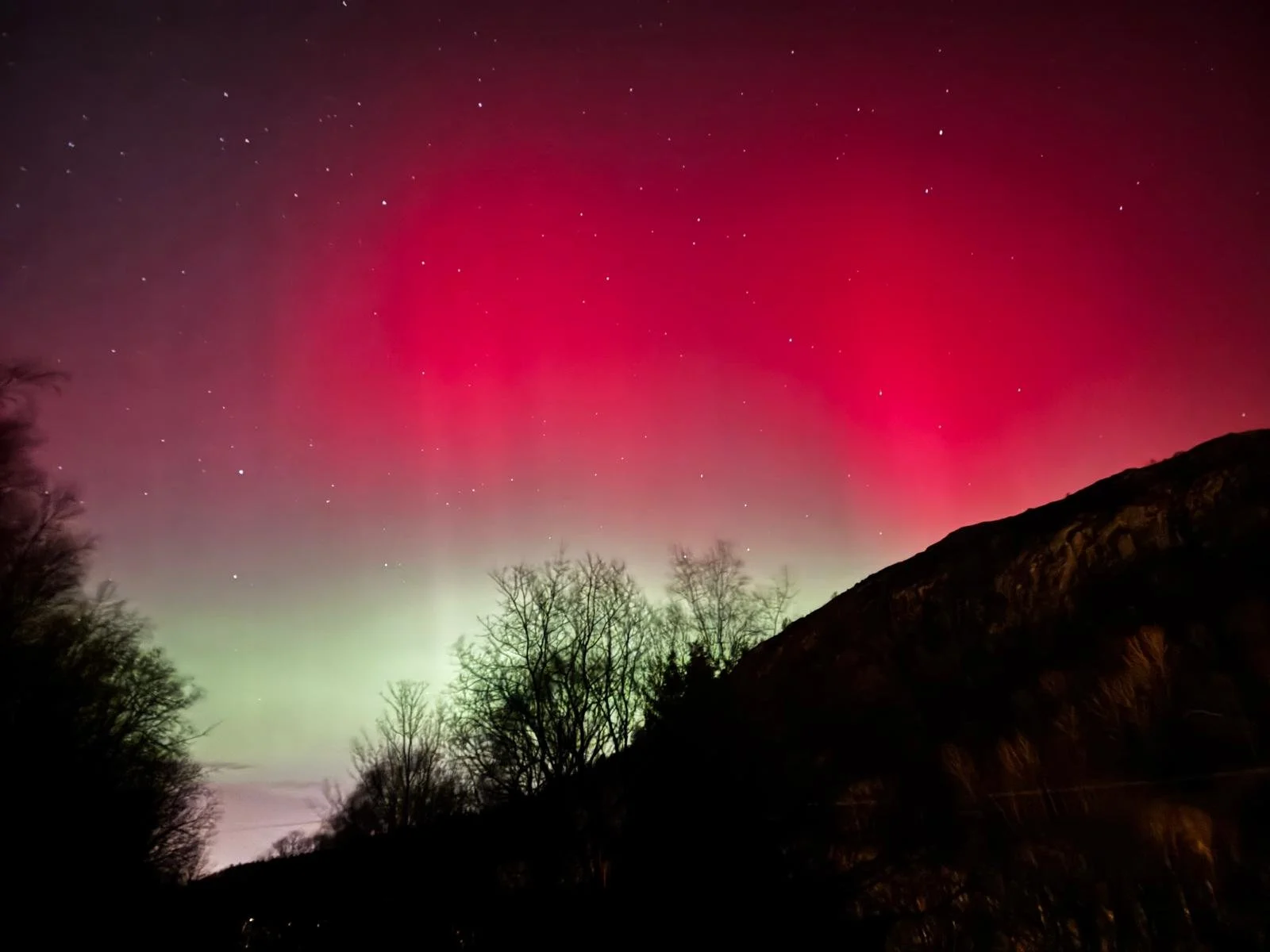
A rare red Aurora Borealis over Figgjo, Norway, captured at peak intensity as crimson and green tones blend across the night sky. This striking display shows the uncommon red aurora phenomenon, which appears higher in the atmosphere and is far rarer than the typical green Northern Lights.
📸 Photo credit: Michael Caldwell
It started with a message — just one line from my friend, Michael Caldwell:
“Aurora over my neighborhood right now.”
No warning. No build-up. No time to think.
I dropped everything — book half-open, blanket still warm — and moved on instinct alone. The adrenaline hit first, sharp and electric, followed immediately by purpose. I grabbed my keys, called the dogs, and within seconds we were outside, the cold biting my cheeks before the door even shut behind us.
Why I couldn’t sit still
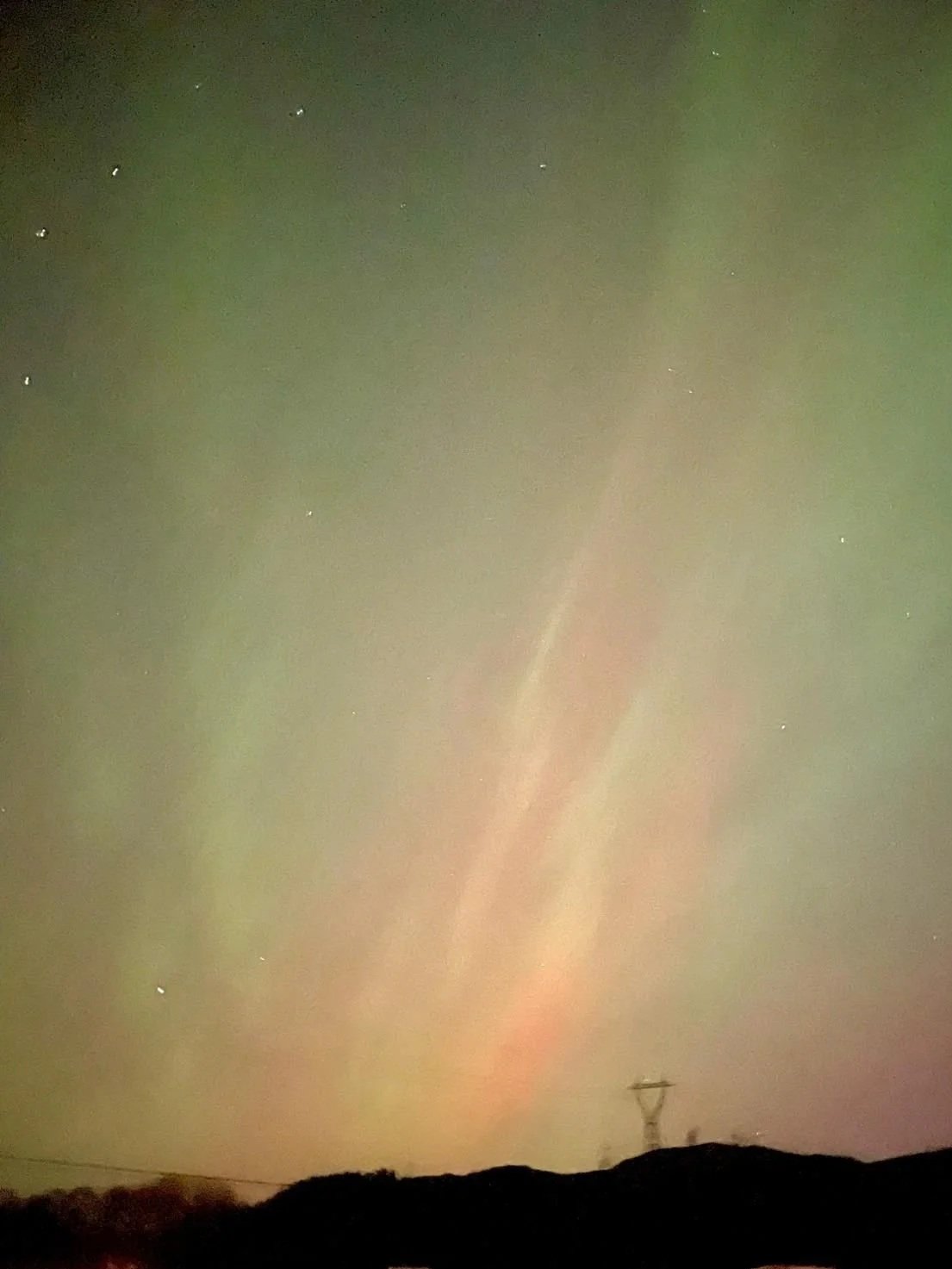
A fading Aurora Borealis over Figgjo, Norway, photographed moments after the main display had passed. The remaining light appears soft and subdued — a quiet afterimage of the Northern Lights, lingering like a ghost in the sky. This image captures the subtle beauty of the aurora as it gently disappears.
What pushed me out the door wasn’t just any Aurora Borealis — it was the hope of red aurora.
Most people know the Northern Lights as green: luminous curtains, gentle waves across the sky. Green is beautiful, and it’s the most common color we get to see. But red aurora is rarer. It appears higher in the atmosphere, often faint, almost shy — a glow that doesn’t ask for attention. You don’t go chasing the aurora casually when it’s red. You chase it because you know you might never see it again.
Driving into the dark
Lyra and Hugo were secured in their cages in the back of the car — safe, calm, unaware of the urgency in my movements. I slid into the driver’s seat, started the engine, and felt that familiar shift: the moment when thinking stops and motion takes over.
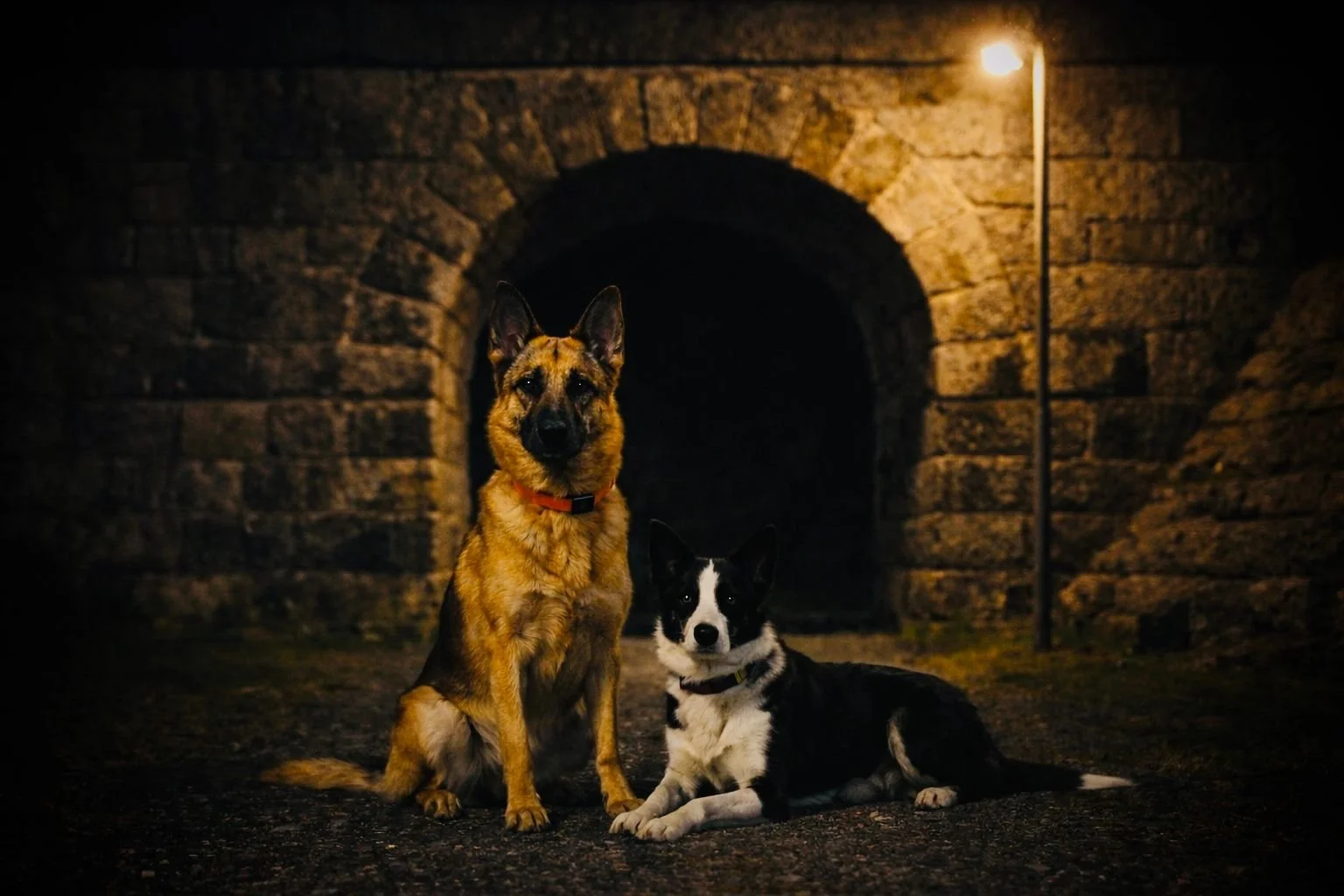
Lyra, a German Shepherd, and Hugo, a Border Collie, photographed together during a late-night stop in Figgjo, Norway, capturing the quiet companionship of the night.
I started driving out of town, toward Figgjo — toward the darker edges where city lights surrender to forest and open road. Roads like these are made for aurora chasing — where the sky feels closer and heavier, and the noise of the world thins out. My heart raced, not from fear, but from that very human hunger to witness something cosmic before it disappears.
When the sky doesn’t wait
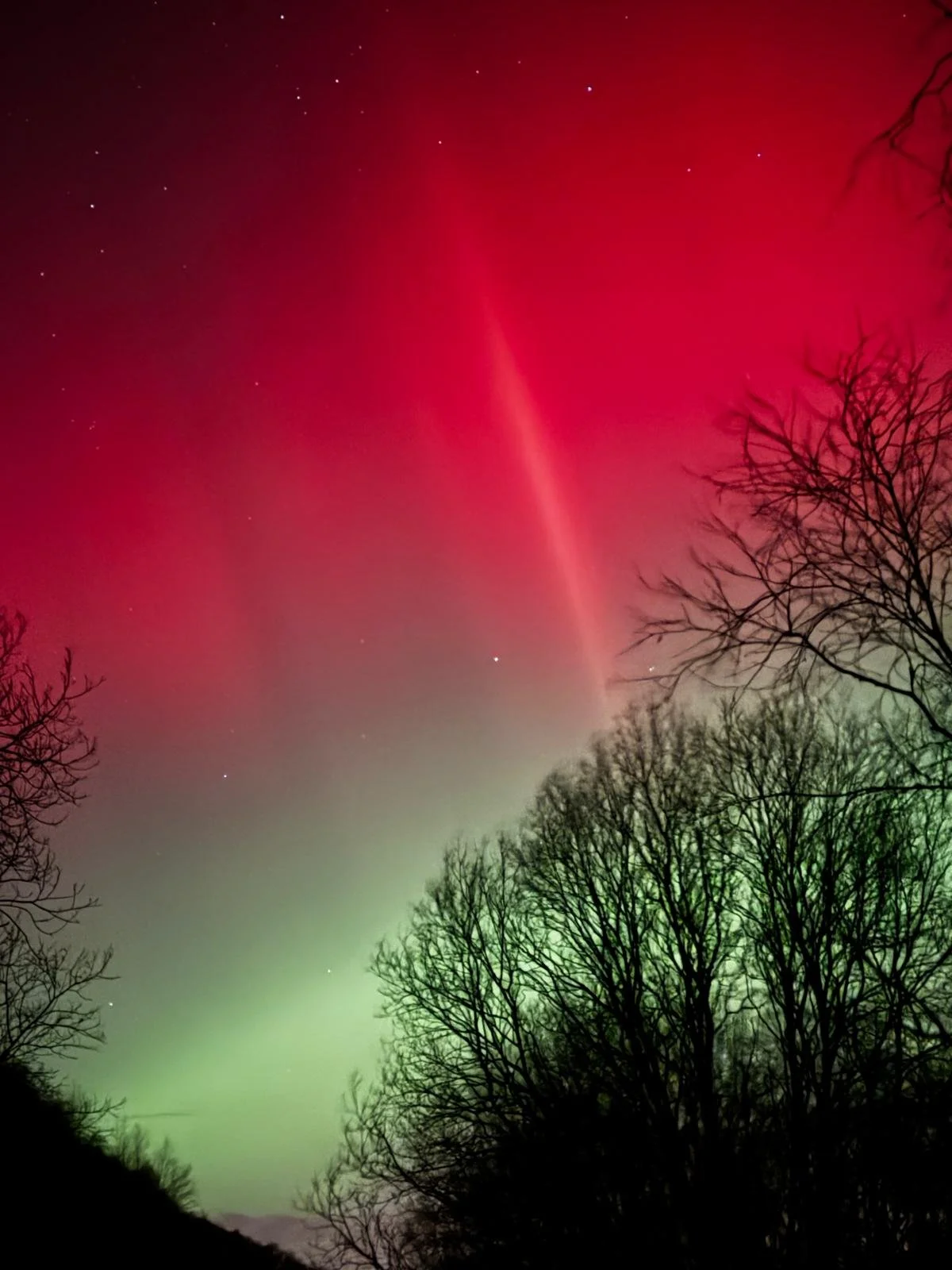
A dramatic vertical red Aurora Borealis over Figgjo, Norway, showing vivid crimson light rising through the night sky above silhouetted trees. This rare aurora formation highlights the intensity and elegance of red auroral activity.
📸 Photo credit: Michael Caldwell
The road was nearly empty — black asphalt, sparse streetlights, villages already asleep. Everything felt suspended, like the night itself was holding space for something rare. I drove alert and focused, carried by that wired calm that only comes when instinct is steering.
Then my phone buzzed again.
“It’s fading now.”
Of course it was. The Northern Lights don’t wait. They never have. The sky doesn’t pause for late readers or second chances. It moves on, indifferent to how badly we want to arrive on time.
Still, I kept driving.
Because sometimes you don’t chase things to catch them — you chase them just to say you tried.
Almost fooled by the night
Somewhere on the road toward Figgjo, something caught my eye. Colors ahead — suspended low against the dark. Not green. Not red. But purplish. Blue. Soft and unfamiliar.
I slowed down.
Wait a minute.
For a brief, ridiculous moment, my brain leapt ahead of reality. Another variety of Northern Lights? A rare color I hadn’t seen before?
Then I got closer.
It was an overpass — decorated in purplish-blue Christmas lights.
I laughed out loud, sharp and relieved. Not disappointment — just the humor of wanting something badly enough to believe almost anything for a second. I shook my head and kept driving, amused and very aware of how open I’d made myself to wonder.
Standing under what remained
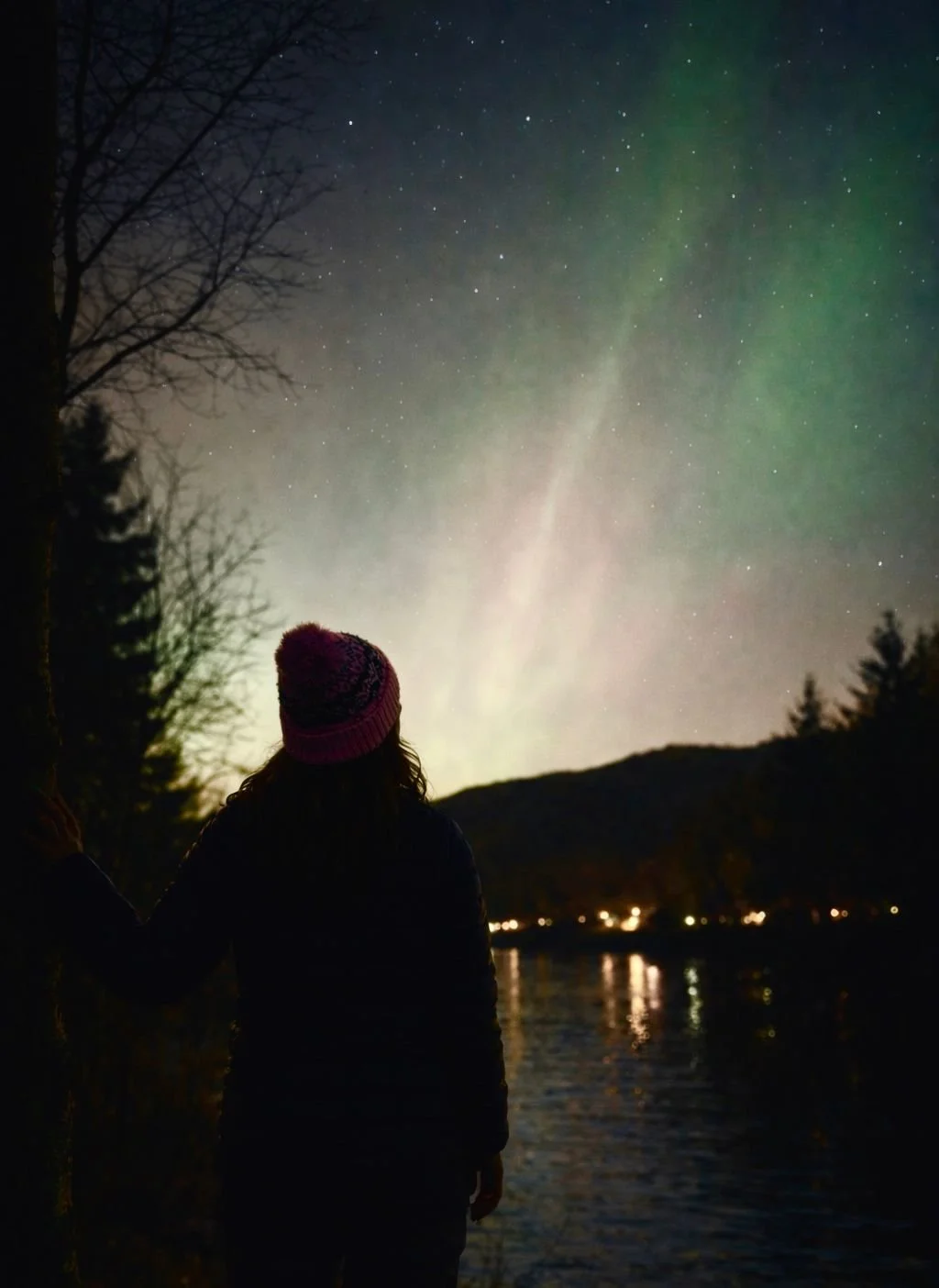
Standing by the water in Figgjo, Norway, watching the faint, lingering traces of the Aurora Borealis as it slowly fades from the night sky. The light is subtle and restrained — a quiet afterimage rather than a full display — capturing the stillness and awe of witnessing the aurora’s final moments.
Eventually, I pulled over along a quiet forest road and stepped out into the cold. The dogs stayed inside, calm and safe. The night wrapped around me — still, dark, honest.
I didn’t rush the sky.
I let my eyes adjust. Let my breathing slow. Then I tilted my head back.
There was no explosion of color. No dramatic movement. Just a faint aurora high above me — pale, restrained — like the sky had exhaled something delicate and was already taking it back.
Catching her ghost
And something surprised me.
I didn’t feel disappointed.
What I felt was quiet awe.
Even in her faintness, the Aurora Borealis was unmistakably present — a soft pull, a haunting beauty that didn’t announce itself. Beauty that trusted it would be noticed.
I felt like I had caught her ghost overhead.
Not the spectacle.
Not the show.
But the proof.
Some beauty isn’t meant to scream “Look at me.” Some beauty whispers — and waits for the right eyes.
I know I will notice it. Every time.
Enough
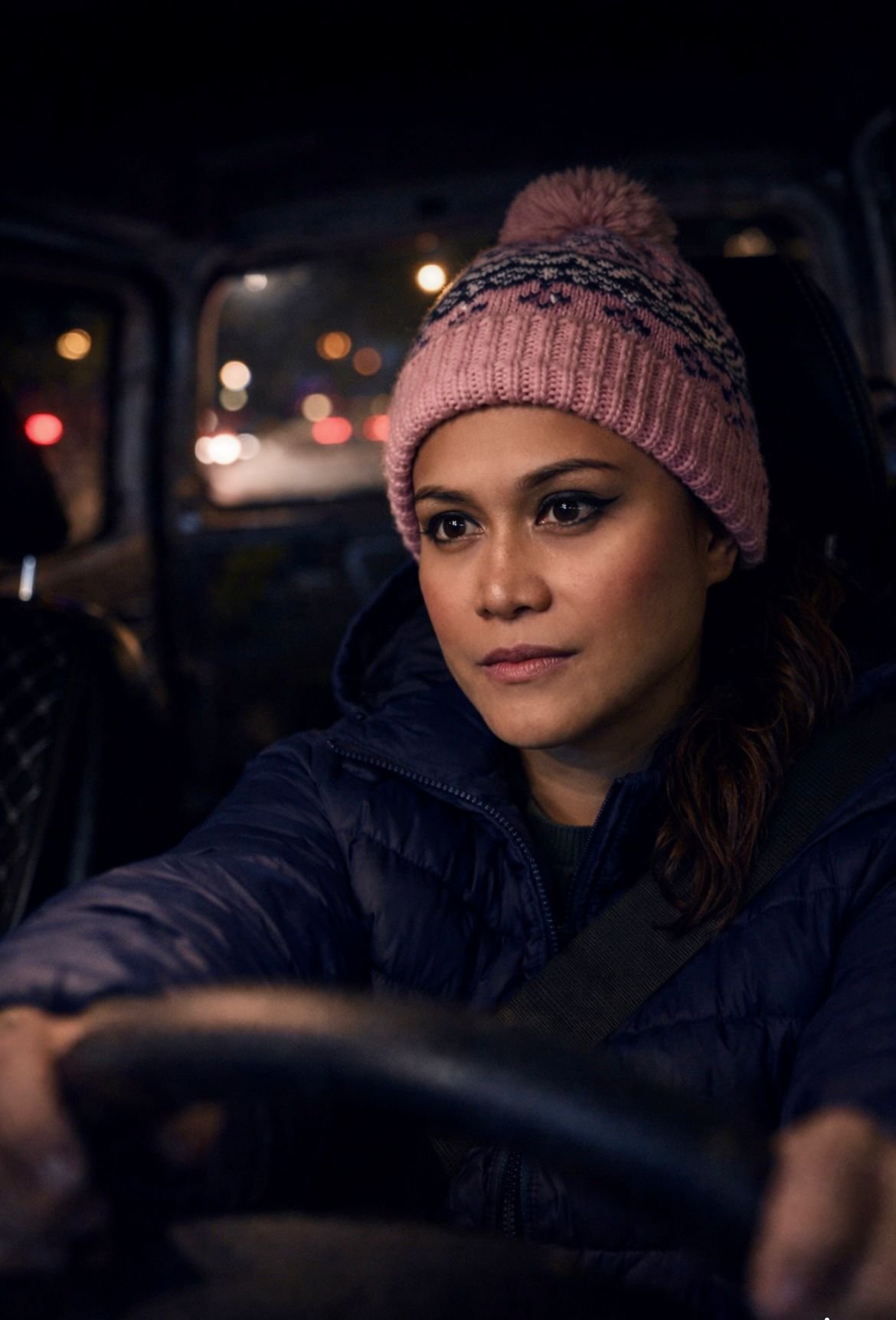
April Joy Alfarnes driving at night in Norway during an Aurora Borealis chase
Driving home later, the road quiet and the dogs resting behind me, I felt steady. Complete. Like the night had given me exactly what it meant to give.
I didn’t see the Northern Lights in full bloom.
But I saw her fading —
and somehow, that was enough.
