Six days exploring Attica—Greece, and the trouble with knowing what you want.
The Seduction of Antiquity
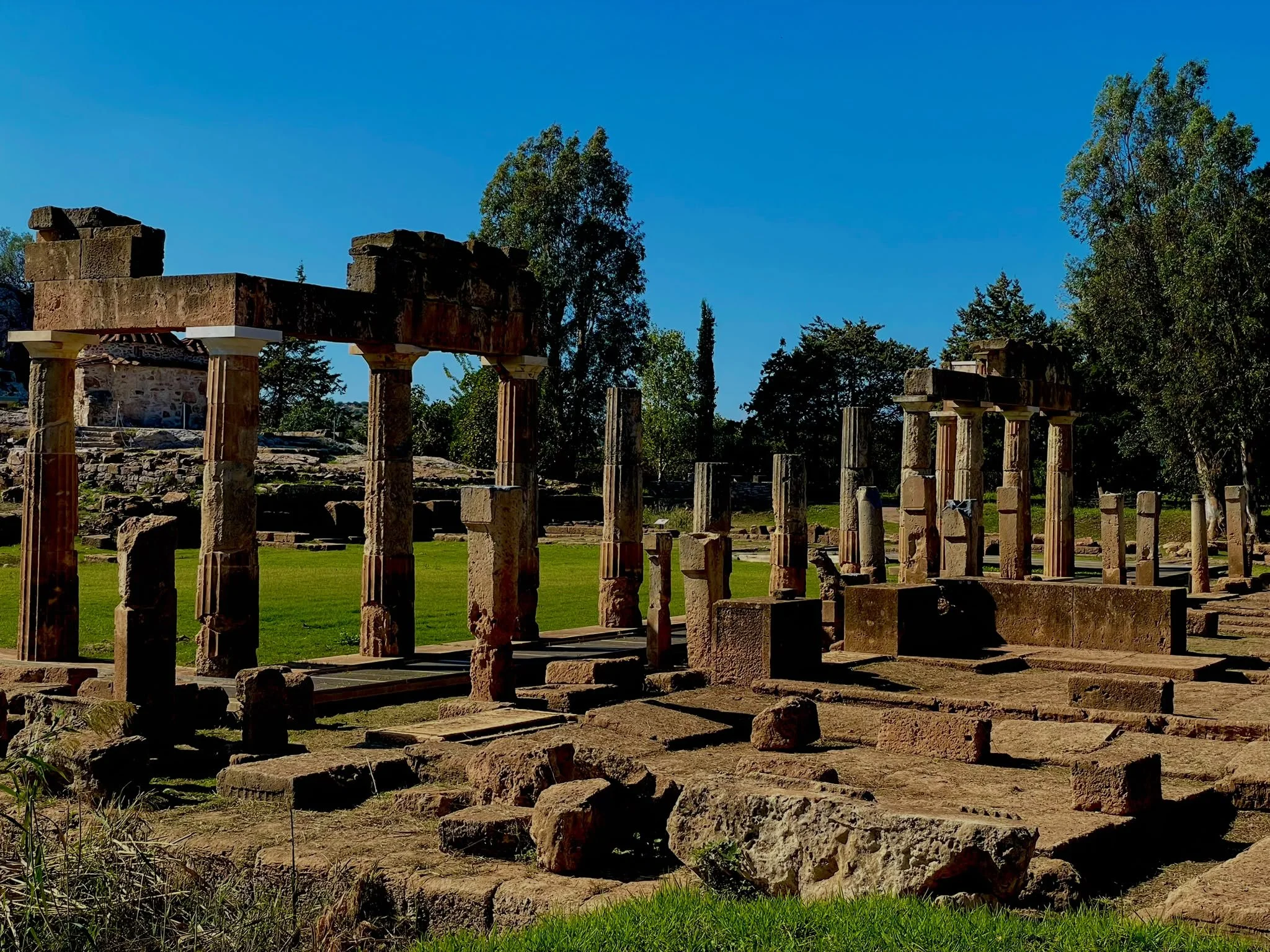
Ancient ruins at the Sanctuary of Artemis in Brauron, also known as Vravrona, in Attica, Greece. Columns of varying heights surround a green courtyard, with several supporting horizontal stone beams. Large blocks and low foundations fill the foreground, while leafy trees rise behind the ruins. Sunlight highlights the rough stone surfaces and casts deep shadows across the site.
There is something faintly ridiculous about travelling thousands of kilometres to stand in front of a damaged building and feel that your life has become richer.
And yet, there I was.
I have always been fascinated by ancient civilisations. Show me a piece of marble with a precisely carved socket and I will happily spend an unreasonable amount of time wondering about the person who made it. Someone measured that opening. Someone held a tool against the stone, made a decision, and left a mark that would outlive everything they knew.
Now I was standing in front of it with a phone.
An impressive contribution from my generation.
At the temples of Attica, the region surrounding Athens, I found myself looking beyond the columns to the lives that had once moved around them. People arriving with offerings, worries, obligations. People who were hungry, distracted, in love, irritated with somebody. People for whom these places belonged to an ordinary day.
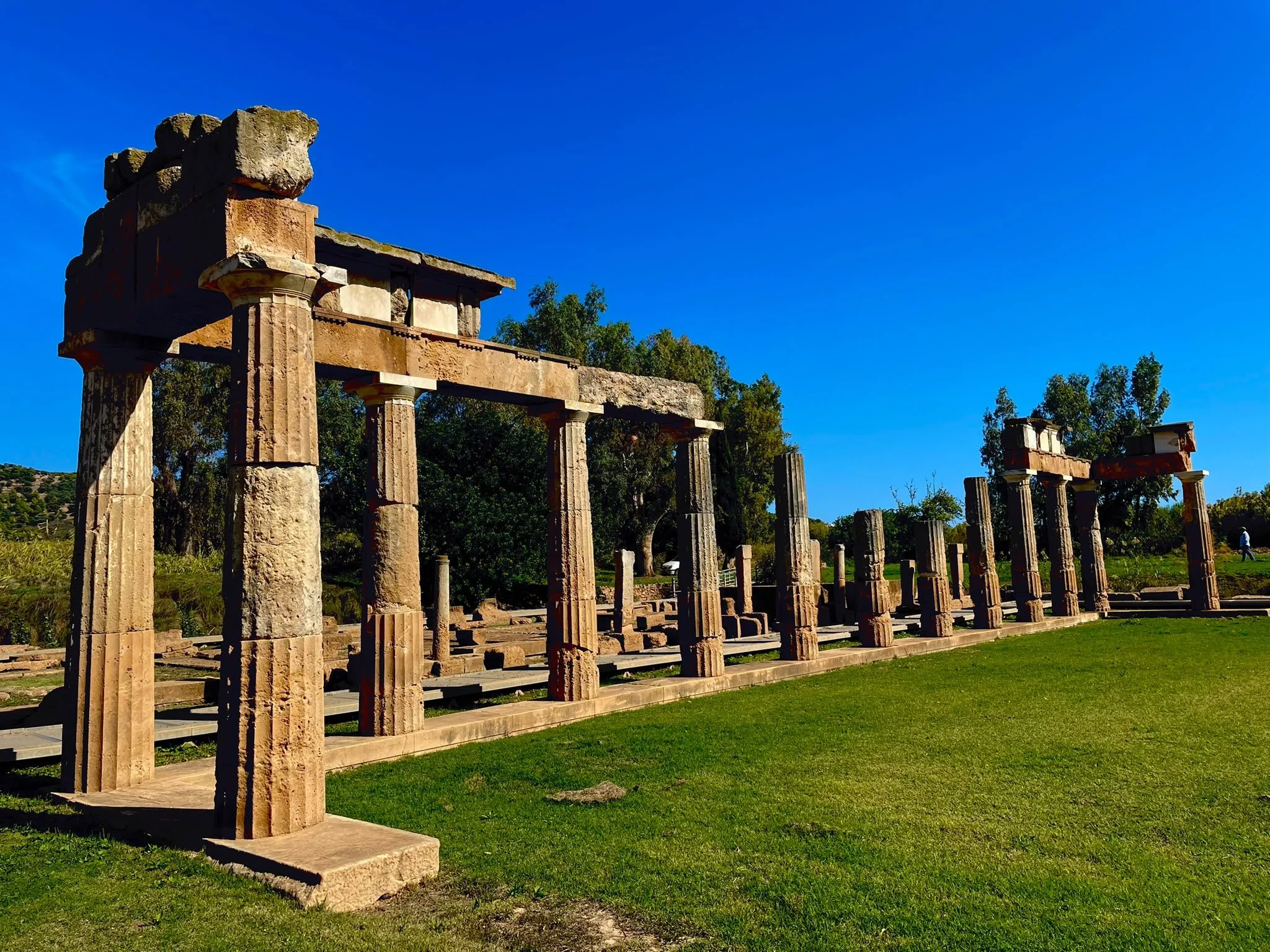
An angled view along the colonnade at the Sanctuary of Artemis at ancient Brauron, in modern-day Vravrona, Attica, Greece. Tall, weathered stone columns dominate the left foreground, with shorter and partially preserved columns extending into the distance. Horizontal stone beams connect several columns above a paved walkway, forming part of the sanctuary’s stoa, or covered colonnade. A green lawn fills the foreground, with trees behind the ruins beneath a vivid blue sky.
I wanted to stand on the ground they had stood on and, for a moment, make the distance between us feel smaller.
Of course, the past was no paradise. Its beauty existed alongside cruelty, inequality, and suffering. Still, there was something deeply moving about the evidence of human care: the effort someone had made to get a line straight, a surface smooth, a structure worthy of what they believed.
I came to Greece curious about what remained.
I had given considerably less thought to what might begin.
Welcome to Greece, You Idiot!
My introduction to the country involved rather less marble and rather more administrative distress.
There was a car-rental office somewhere beyond the airport. There were arrangements that apparently did not mean what I thought they meant. There was additional money to pay, transport to negotiate, and the gradual realisation that my holiday had begun with a practical examination for which I had not studied.
I had come seeking ancient wisdom.
The first lesson was expensive.
Eventually, I acquired a small Fiat and the responsibility of directing it through unfamiliar surroundings.
Here is a contradiction I have learned to accommodate: I am adventurous, and I would also appreciate advance notice of precisely how frightening the adventure intends to be.
Preferably with photographs.
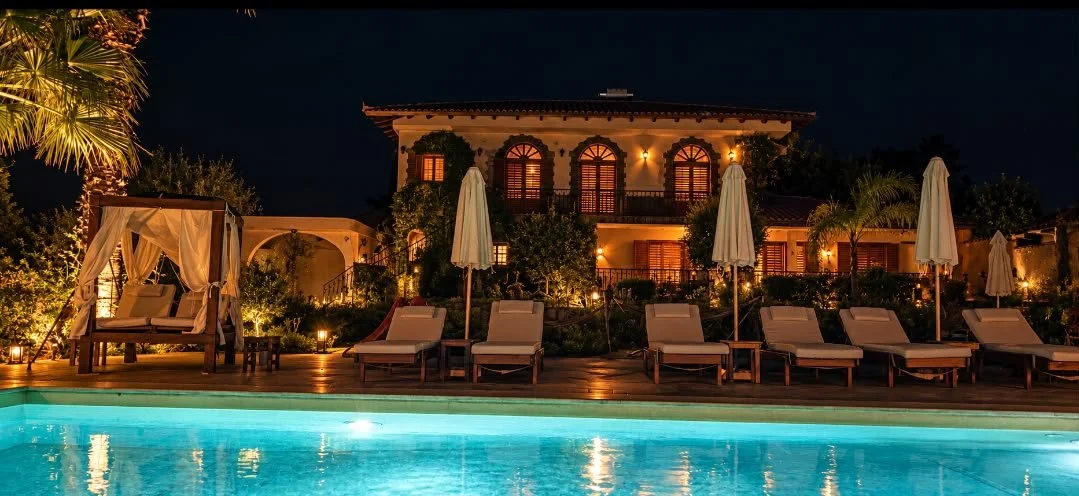
Night view of Villa Artemida in Vravrona, Attica, Greece. Warm golden lights illuminate the two-storey villa, its arched upper windows, and surrounding palms and greenery. Sun loungers and closed parasols line the wooden pool deck, with a curtained canopy daybed on the left. The turquoise-lit swimming pool fills the foreground, reflecting the lights against the dark sky.
I wanted freedom, coastal roads, spontaneous discoveries. I also wanted the navigation to explain itself clearly and stop behaving as though every junction were an opportunity for personal growth.
But there is a particular satisfaction in arriving somewhere after all that. A door closes behind you. Your bags reach the floor. For a few moments, nothing requires an answer.
I was in Greece.
I could begin again in the morning.
What Do You Truly Desire?
Six days sounds generous until you start placing things inside it.
Temples. Beaches. A national park. A lake. Food. Meeting Greeks. Driving. Getting lost. Recovering from getting lost. Standing still long enough to understand why you came.
I could easily have turned the week into a collection of completed destinations. I know myself. Curiosity can become a demanding employer.
So beneath the practical question—Where shall I go tomorrow?—another one began to emerge.
What do you truly desire?
My first answer was simple: I wanted to feel like a local.
An ambitious wish for a woman still negotiating with her GPS, but there we are.
I wanted groceries in the kitchen. Familiarity with a stretch of road. Somewhere to return to at the end of the day. I wanted to stop measuring the value of an afternoon by how much I had managed to fit into it.
As a Filipina living in Norway, I am familiar with the work of finding my place. You learn different rhythms, different ways of speaking and being quiet. You adapt, sometimes so gradually that you forget to ask which parts of your life still feel entirely your own.
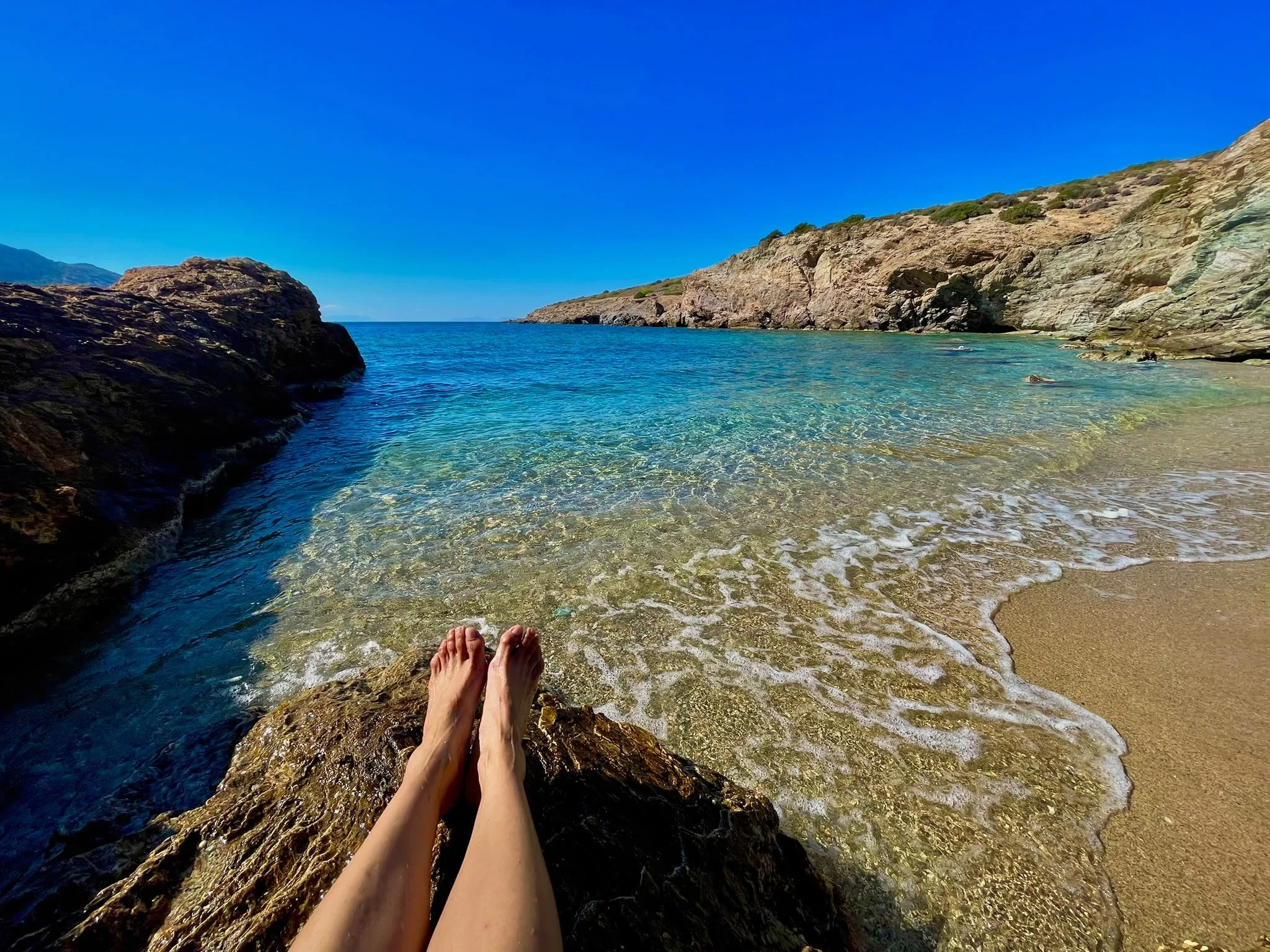
A view from a shoreline rock across a small cove near KAPE Beach in Legrena, Attica, Greece. Bare legs extend into the foreground as gentle waves wash over the sandy beach to the right. Clear shallows reveal submerged stones, deepening to turquoise and blue towards the open sea. Rugged, sparsely vegetated cliffs curve around the bay beneath a cloudless blue sky.
Here, temporarily, I could follow my attention.
If something interested me, I could stop.
If the water looked inviting, I could swim. Such small freedoms. Such an enormous effect.
In the Footsteps of Gods
At Cape Sounion, the Temple of Poseidon stood above the sea with the sort of setting that makes you understand why people built something sacred there.
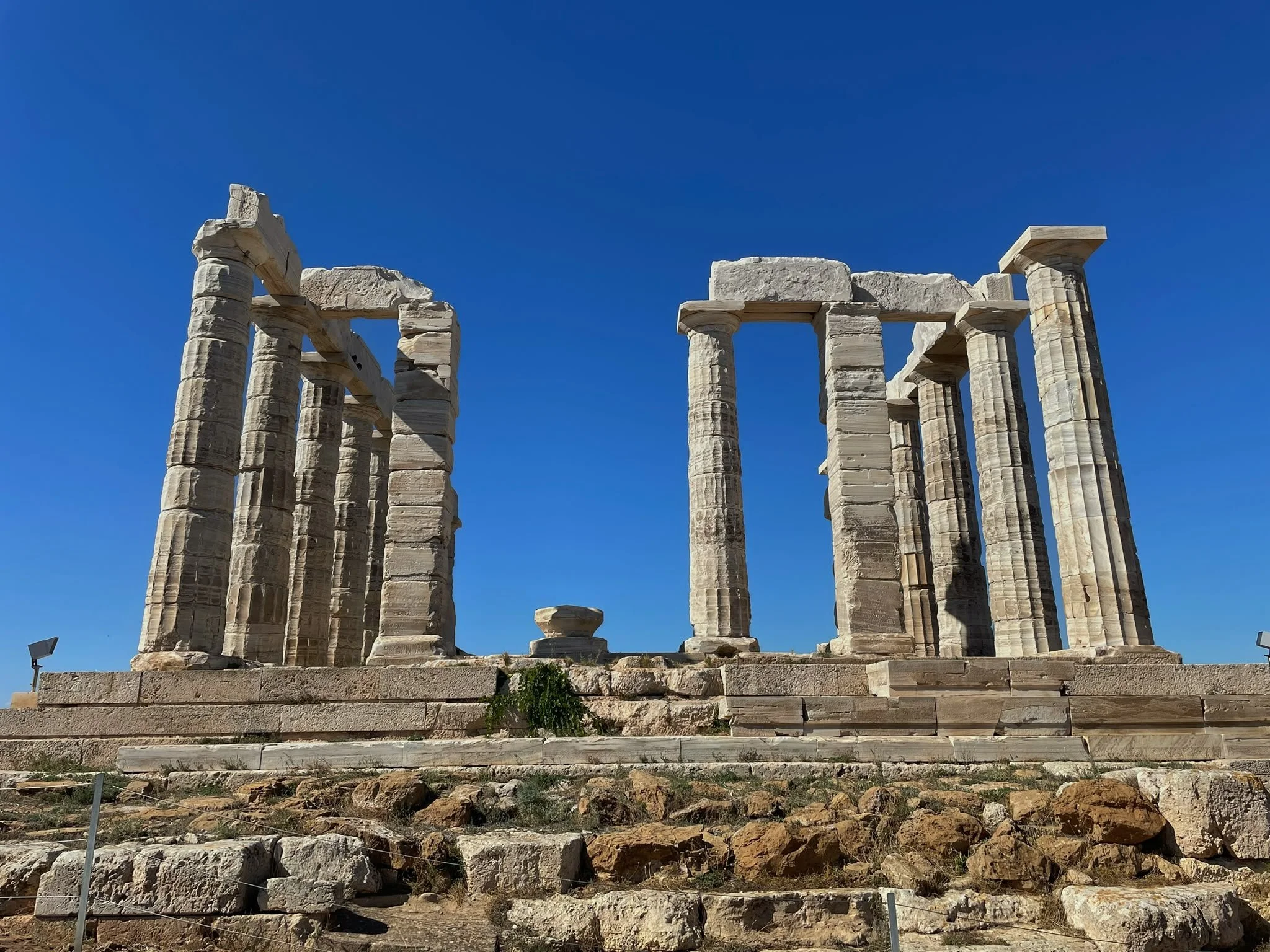
A low-angle view of the Temple of Poseidon at Cape Sounion in Attica, Greece. Two groups of tall marble columns support surviving sections of horizontal stone beams, with an open gap between them. Bright sunlight reveals the columns’ fluted surfaces and stacked construction. Stone steps, scattered blocks, and rocky ground fill the foreground beneath a cloudless blue sky.
The horizon does a great deal of persuasive work.
I looked at the columns, then at the water, then back at the columns. There are places where taking a photograph feels almost compulsive, as though you need proof that the world briefly arranged itself so well.
But a photograph cannot quite contain the experience of standing there. The scale. The air—as though I were breathing something of a world where gods once walked, standing on the very ground that had held their footsteps, letting that ancient presence settle somewhere inside my soul. The movement of your eyes between something carefully made and something that appears to go on forever.
Later came the roads through the Sounion area, the strange depth of the Chaos sinkhole, and a small creature whose afternoon briefly became more important than my itinerary.
A tortoise.
Naturally, I stopped.
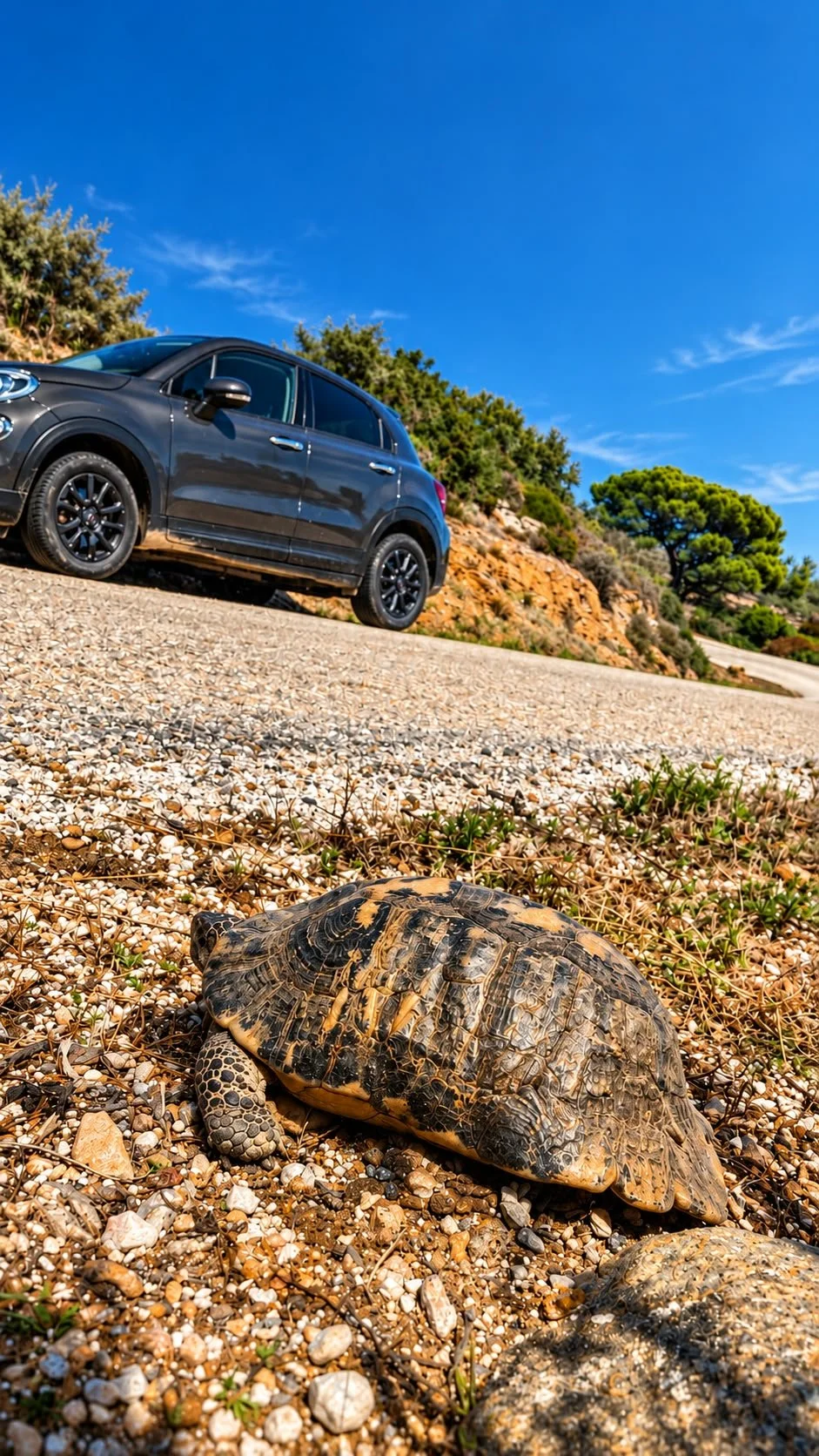
A ground-level close-up of a tortoise resting among pale pebbles, dry grass, and small green plants beside a road in the Sounion area of Attica, Greece. Its domed shell has intricate dark brown and golden markings, and one thick, scaly front leg is clearly visible. A grey car stands in the background beside a rocky slope dotted with shrubs and pine trees beneath a bright blue sky.
There is something wonderfully disarming about an animal proceeding with absolute commitment to its own pace. I had spent part of the trip wondering whether I had enough time. The tortoise appeared to have no interest in the question.
Near Lavrio, I found a little cove and went swimming.
The water was turquoise—the sort of colour that sounds exaggerated until you are in it. From the shore, I could admire it. In the water, I could simply enjoy being there.
At Brauron, the Temple of Artemis invited a different kind of attention. I looked closely at the stones, at the joins and cuttings, at the visible differences between old material and later reconstruction.
Trying to understand how something was made can be its own form of wonder.
And then, at Lake Vouliagmeni near Athens, tiny fish began attending to my feet with a level of enthusiasm I had not requested.
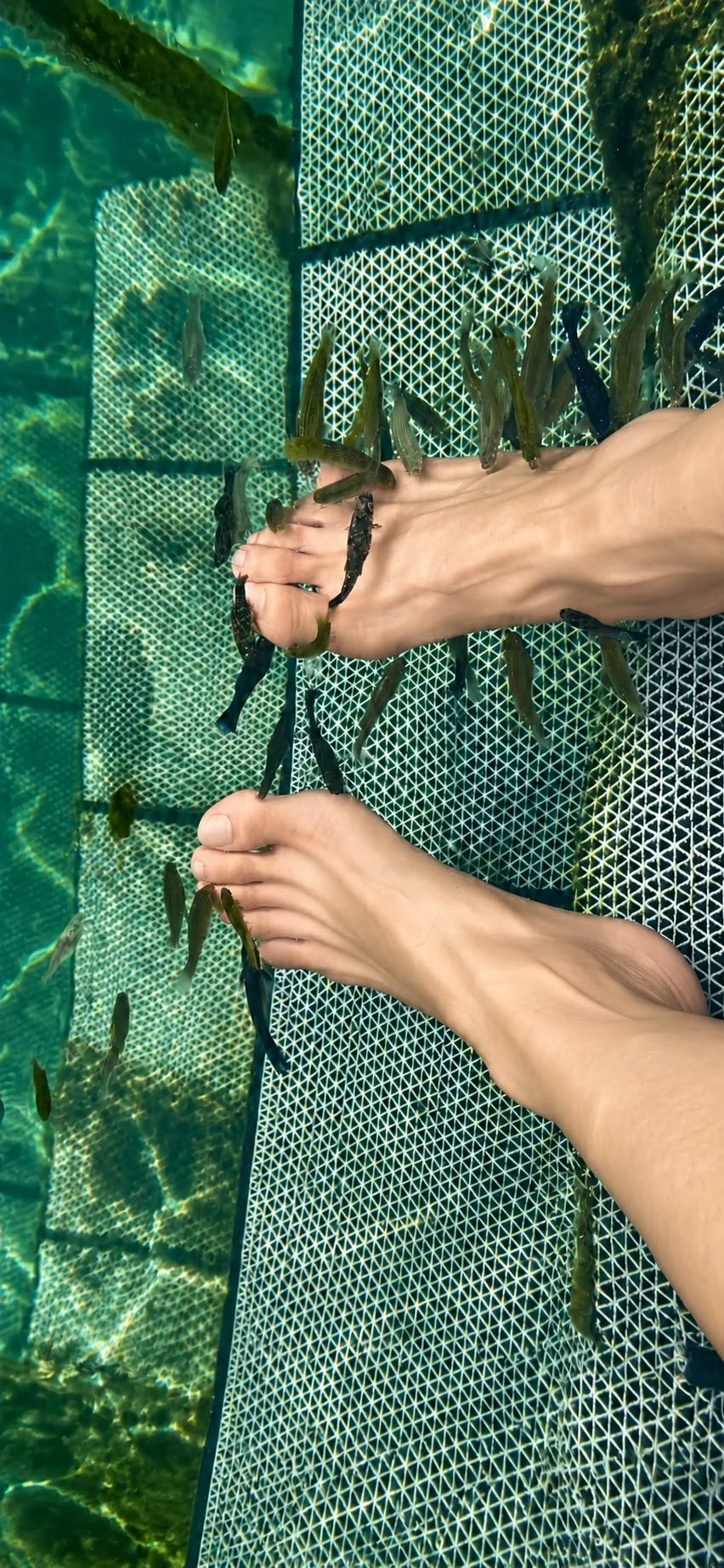
A close-up looking down at bare feet resting on metal mesh steps beneath the clear water of Lake Vouliagmeni near Athens, Greece. Numerous small, slender fish cluster around the toes and tops of the feet, with several appearing to nibble the skin. Sunlight creates rippling patterns across the submerged steps and green-blue water.
I laughed because it tickled, because it was absurd, because I was sitting in beautiful water being gently dismantled by very small professionals.
There are many ways to have a meaningful encounter with Greece.
Apparently, this was one of mine.
The Greeks, the Introvert, and the Souvlaki
A country becomes more interesting when it begins to interrupt your expectations.
I had brought my own ideas about Greece: ancient history, warm people, expressive conversations, very good food. Greece followed some of the script. The rest required improvisation.
I encountered warmth, reserve, humour, and people who were presumably occupied with their own lives rather than the emotional success of my holiday.
Fair enough.
I am an introvert, although this may be difficult to establish once I become interested in a subject. Then I have questions. Follow-up questions. An observation about a marble socket that apparently cannot wait.
Travel makes me more willing to begin a conversation. Perhaps because the setting already gives us something to discuss. Perhaps because I know the moment will pass.
Food helped.
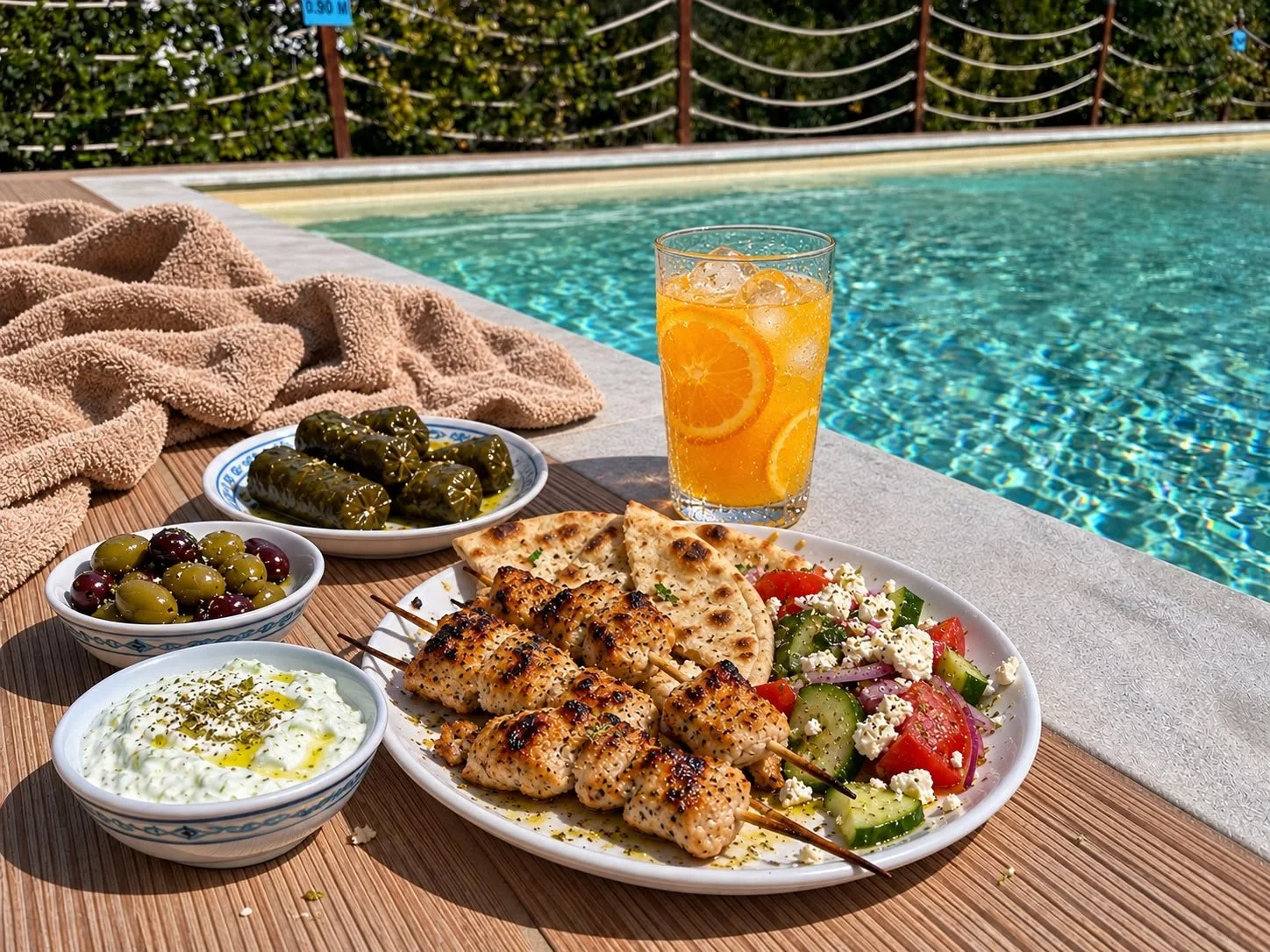
A Greek meal beside the turquoise swimming pool at Villa Artemida in Vravrona, Attica, Greece. Grilled chicken skewers, toasted pita, and a feta-topped salad fill a white plate, accompanied by bowls of dolmades, mixed olives, and tzatziki. An orange drink with ice and orange slices stands behind the food, while a tan towel lies loosely across the wooden pool deck. Sunlight creates shimmering patterns in the water.
There were chicken skewers, feta, dolmades, and the recurring pleasure of sitting down after a day outside. Hunger is an excellent editor. It removes unnecessary complications.
I had arrived with nutritional intentions. Greece made its own suggestions.
I listened.
What stayed with me, though, was the experience of becoming comfortable. Roads began to look familiar. The place I was staying acquired the small reassurance of somewhere I knew how to return to.
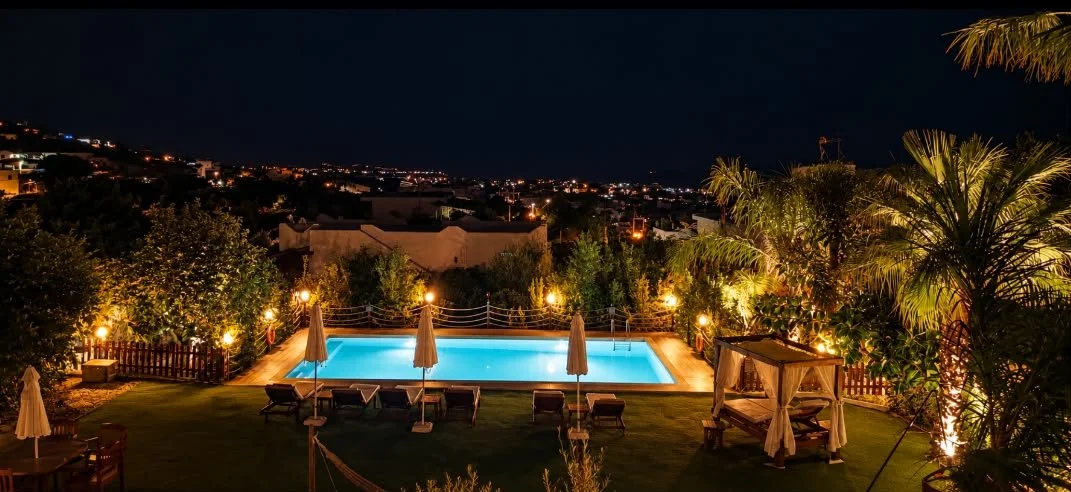
An elevated view of the swimming pool and garden at Villa Artemida in Vravrona, Attica, Greece, after dark. The rectangular pool glows turquoise, surrounded by warm garden lights, sun loungers, and closed parasols. A curtained canopy daybed stands on the lawn to the right beneath illuminated palms. Beyond the garden, scattered houses and streetlights stretch across the distant hillside under a dark sky.
An unfamiliar country was becoming a collection of recognisable things.
I liked that feeling more than I had expected.
The Gods Were Never the Whole Story
Somewhere during the week, I began to feel unusually present.
I noticed it in small ways. I was less inclined to hurry through a beautiful place. An ordinary evening could feel worth anticipating. I could enjoy a moment without immediately arranging the next one.
Perhaps distance helped. Perhaps sunlight did. Perhaps curiosity, properly fed, makes more room inside a person.
When you travel, you sometimes meet your kind of soul. You hit it off. Conversation comes easily and stays with you long afterwards, while you are doing something else.
How easily you catch yourself smiling.
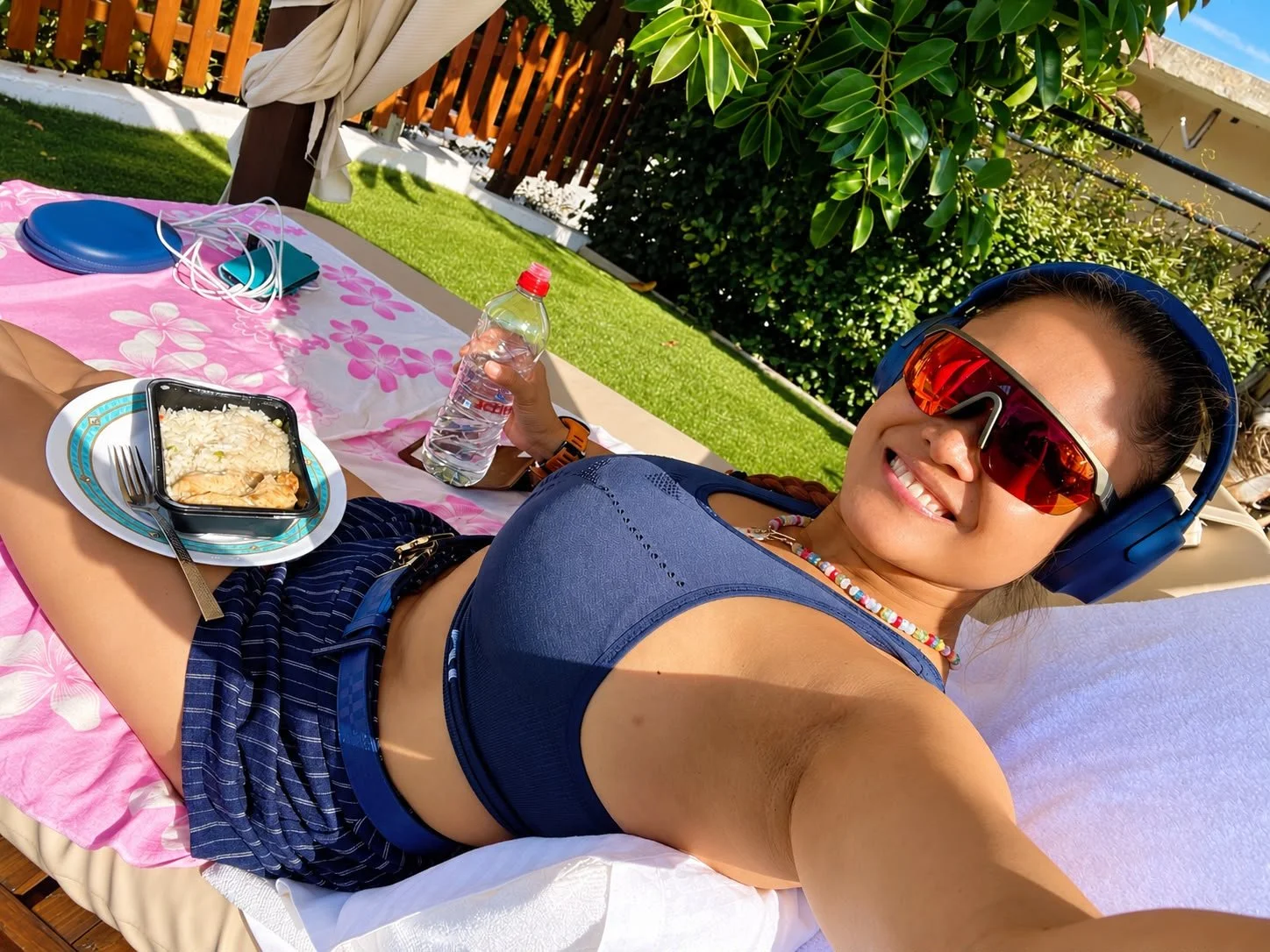
I’m reclining on a cabana daybed at Villa Artemida in Vravrona, Greece, smiling in the sunshine. I’m wearing blue headphones and mirrored sunglasses, with a meal on my lap and a water bottle in my hand. A sunlit lawn, leafy trees, and a wooden fence surround the daybed.
I liked the woman I was in Greece. Curious, occasionally ridiculous, delighted by ancient masonry. I also liked how little effort it sometimes took to feel understood.
There is a particular pleasure in being met with warmth when you have grown accustomed to explaining yourself. You begin a thought and discover there is room to finish it. Your enthusiasm finds an answering enthusiasm. You can be thoughtful, playful, affectionate, loving, and feel no need to apologise for the combination.
I found myself lingering.
For a woman who had arrived determined to make the most of six days, I became surprisingly willing to forget the time.
I did, in fact, miss my goddamn flight.
Perhaps that was the wish beneath my question all along. To feel alive, cherished, and at peace. To discover that excitement could have gentleness in it, and that ease could be something you looked forward to with your whole attention.
At the temples, I had tried to imagine the people behind the stones. Their ambitions, their rituals, the ordinary lives unfolding around those magnificent structures.
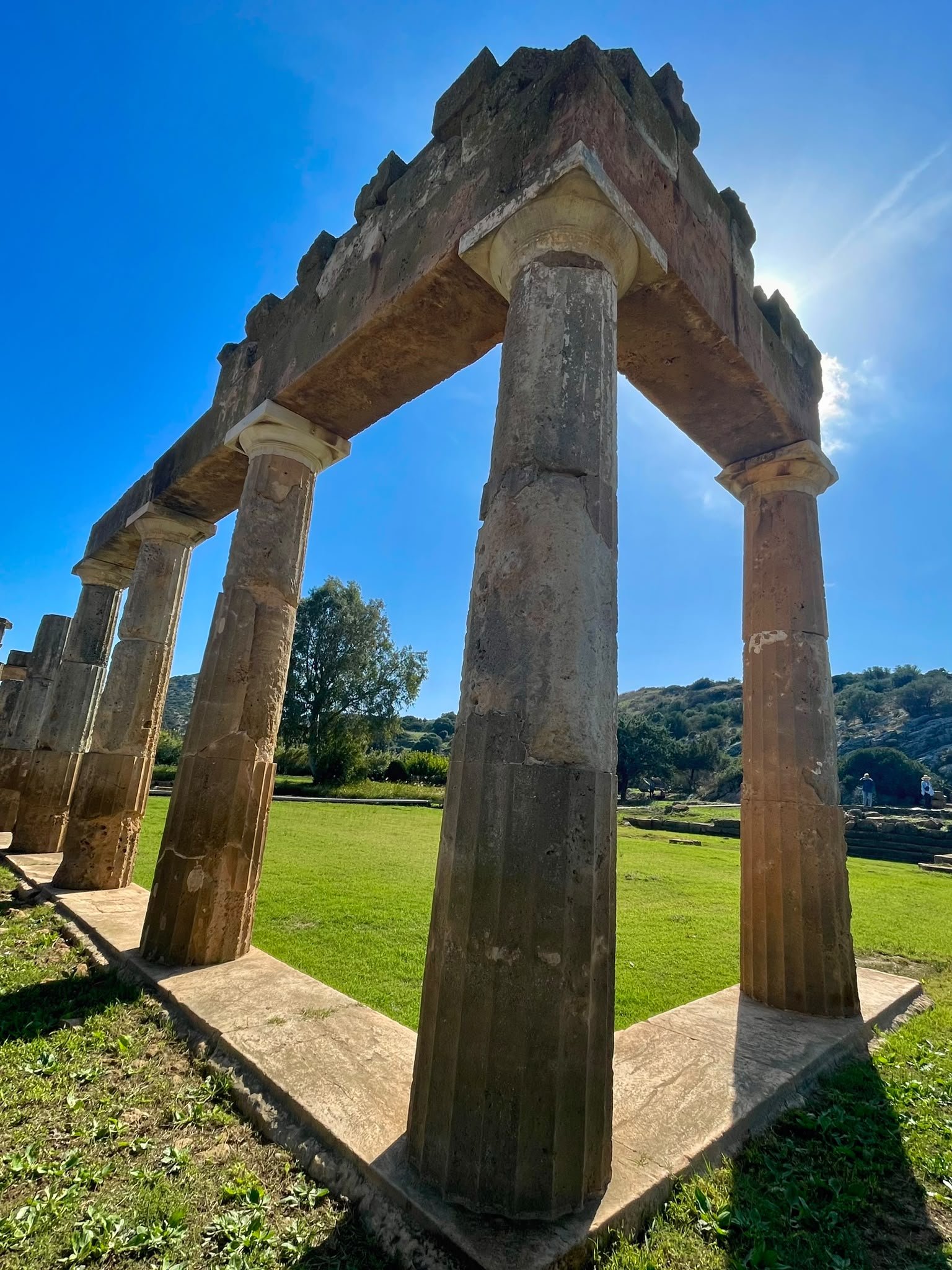
Looking upwards from the corner of the colonnade at the Sanctuary of Artemis in Brauron, Attica, Greece. A tall foreground column supports two intersecting stone beams, while other columns recede to the left. Rough surfaces, fluting, and joins between stone sections are visible. Sunlight peeks from behind the upper stonework, with a green lawn, trees, and a rocky hillside beyond.
Now I kept thinking about the smaller things that must have mattered to them too.
A tender voice. A welcome. The approach of an evening they wished would last a little longer.
Thousands of years, and still so much of being human could fit inside a moment like that.
And to think I came all this way looking for ancient gods.
Bloody Greeks. They do have a way of complicating one’s philosophical itinerary.
Beautiful Detour
Before leaving, I bought two tiny fridge magnets. A tortoise and a taverna.
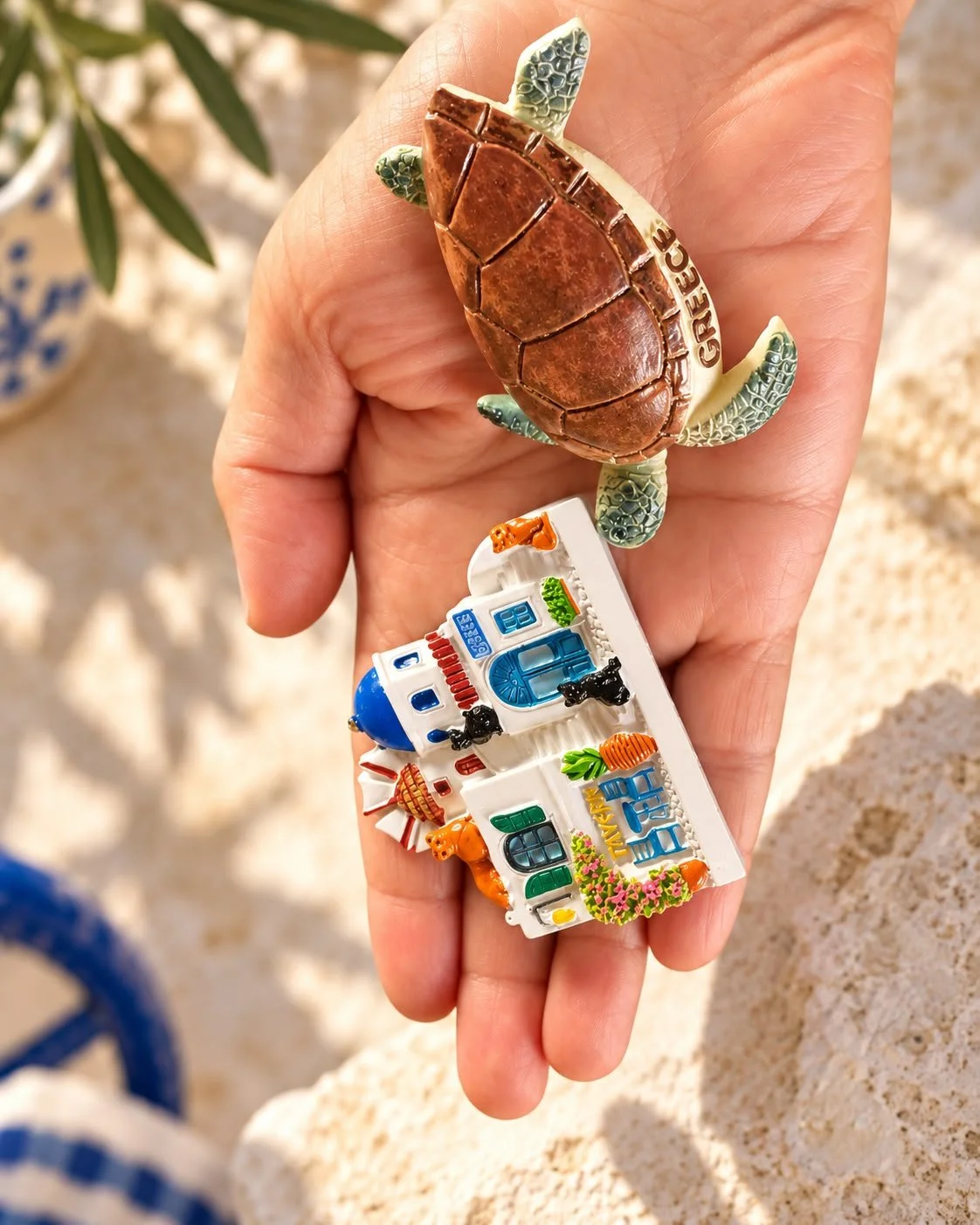
Two souvenir magnets rest in my open palm in warm sunlight. One depicts a sea turtle with a glossy brown shell, green flippers, and the word “Greece” along its side. The other shows a miniature white Greek taverna with blue chairs, colourful doors, tiny cats, and pink flowers. Pale textured stone and softly blurred greenery form the background.
After all those temples, those were the things I chose to bring home: a small encounter beside a road, and the promise of somewhere to sit, eat, and enjoy being alive.
I liked their modesty.
At home, among the usual obligations, they would return me to particulars. A stretch of coast. A drink with a stranger, a walk by the beach at night like lovers do. The colour of the water. My own laughter. The pleasure of having nowhere else I needed to be for a little while.
Some parts of a journey are easy to describe. You can name the temple, locate the beach, explain which road you took and whether you would take it again.
Other parts remain attached to a mood, a kiss, a pause, an unremarkable detail that has somehow become precious.
I had called this journey Beautiful Detour drawn to a country where the landscape still carries the names of gods. I thought I would spend the week looking backwards, trying to imagine the lives that had filled those ancient places.
Instead, I became more attentive to the life unfolding around me.
I returned with photographs of ruins and an unreasonable fondness for a small Fiat that had patiently accommodated my attempts to drive like a local.
I returned feeling softer in some places, braver in others.
And somewhere between the marble and the sea, I had found more to miss than I expected.
I am still smiling about it.
A Practical Note: Six Days in Attica, Greece
My base: Vravrona, near Artemida on Attica’s eastern coast, within easy reach of the Sanctuary of Artemis at Brauron.
Places I explored: Cape Sounion and the Temple of Poseidon; Sounion National Park and the Chaos sinkhole; Lavrio and its nearby coves; the Sanctuary of Artemis and its museum; and Lake Vouliagmeni.
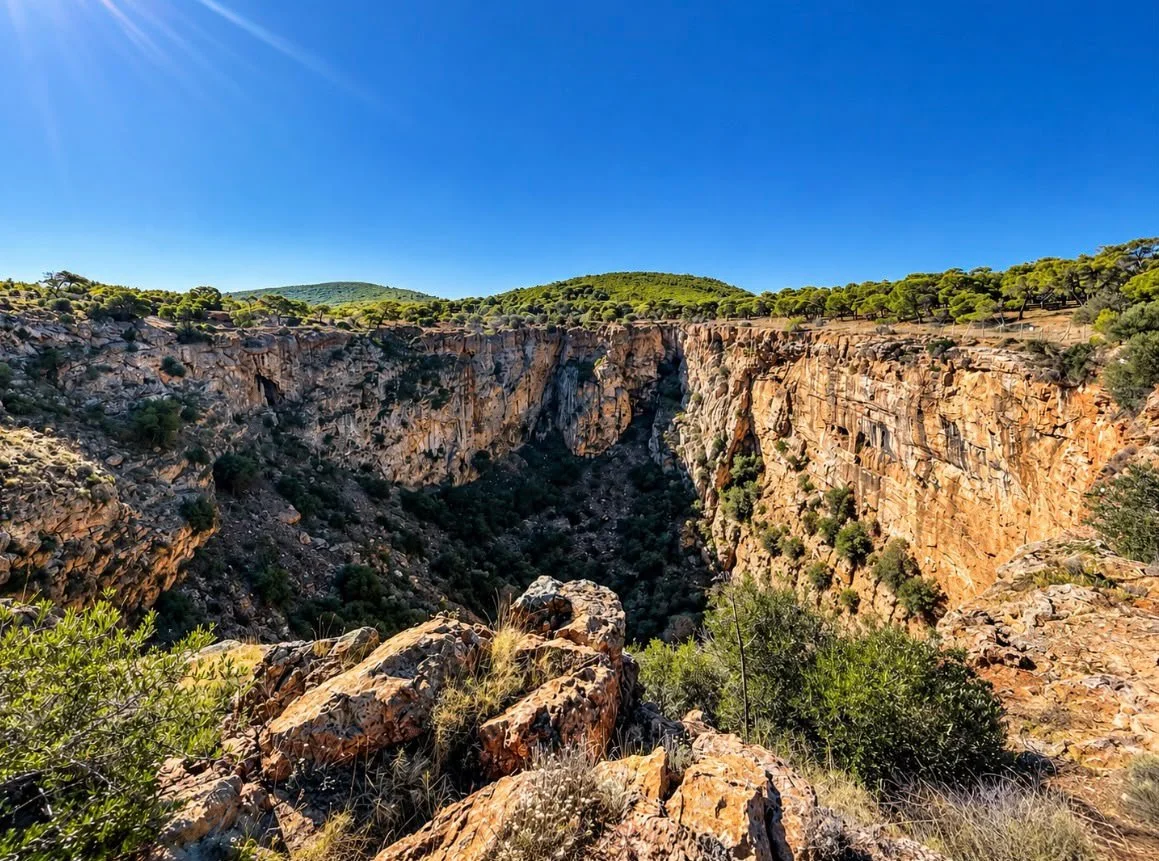
A panoramic view into Chaos Sinkhole in Sounion National Park, near Lavrio in Attica, Greece. Sheer, fractured cliffs in warm ochre and grey tones encircle a deep hollow filled with dense vegetation. Pine trees line the rim, while rugged rocks, shrubs, and dry grasses fill the foreground. Sunlight illuminates the right-hand cliff beneath a clear blue sky, contrasting with the shaded depths below.
Getting around: I rented a small car, which gave me the freedom to explore coastal towns and stop whenever something caught my attention. I preferred coastal roads where practical and checked routes for motorway and toll sections before setting off.
Planning the days: Leave room between archaeological visits for swimming, meals, and unplanned stops. Six days gave me time to explore this part of Attica without needing to drive into central Athens.
Before visiting: Check current opening hours, admission prices, and swimming conditions directly with each attraction. Keep your departure day rather more organised than I kept mine.
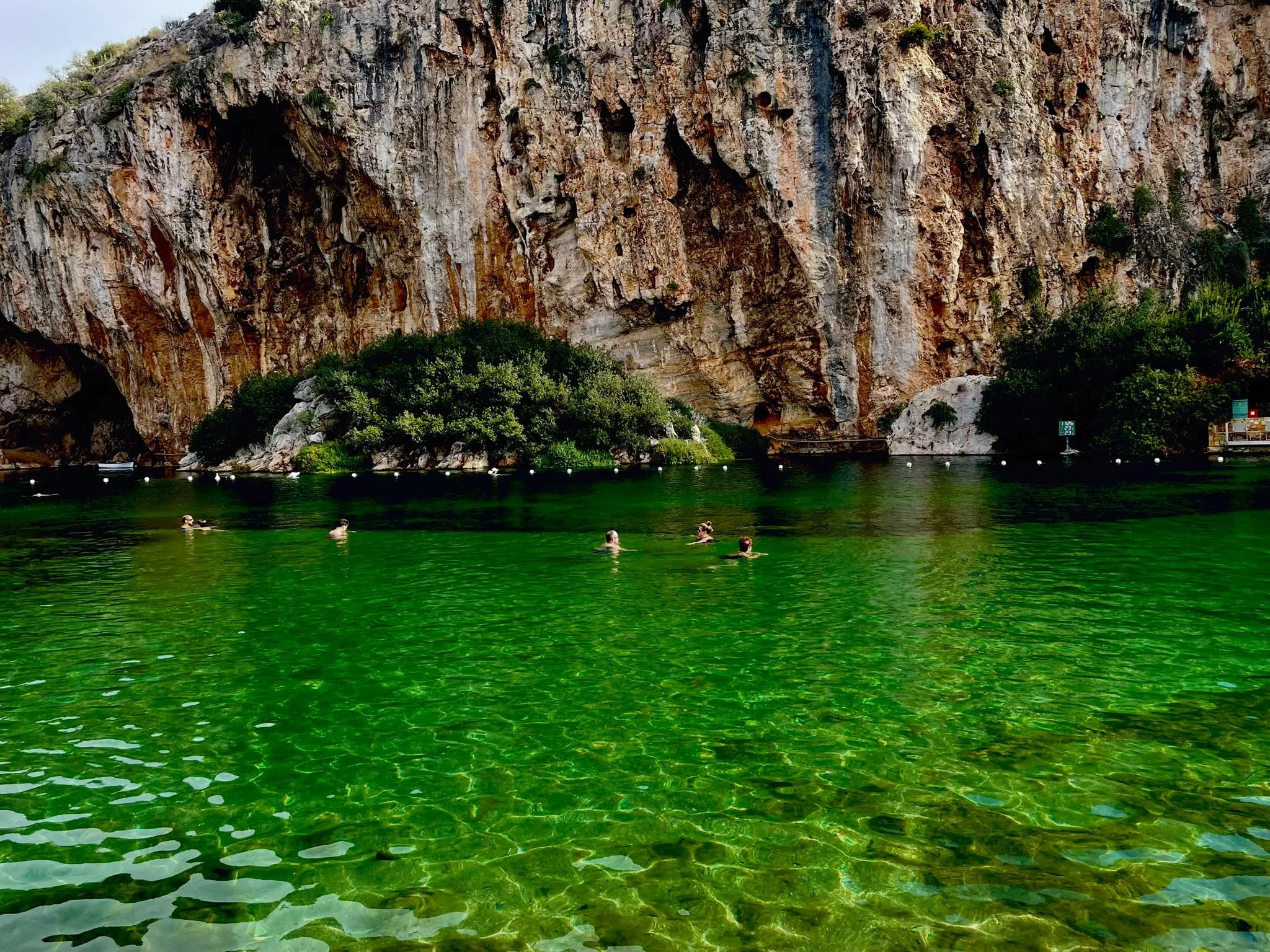
Swimmers relax in Lake Vouliagmeni in Attica, Greece, beneath a steep rock face marked by crevices, dark recesses, and streaks of grey and ochre. Dense shrubs grow along the water’s edge, where a line of white buoys marks the swimming area. Sunlight creates rippling patterns across the clear green shallows in the foreground.
